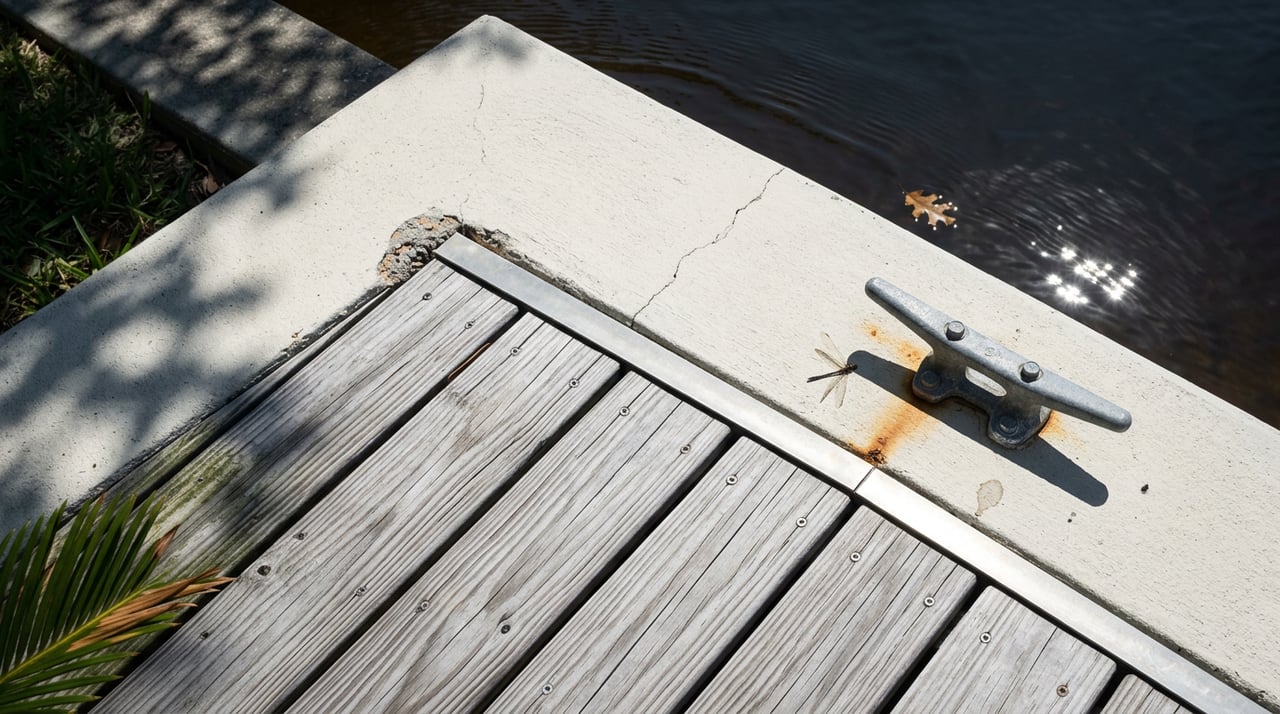
Two Chain of Lakes homes go active the same Tuesday. Same lake, similar footprint, similar photos. One goes under contract in six weeks. The other is still active in July, price cut twice, buyers walking after inspection.
The difference is almost never the water view. It is a stack of paper the second seller never assembled.
The gap the paper file explains
As of the week of July 23, 2026, one local waterfront tracker showed 86 Winter Haven lakefront listings averaging 147 days on market at a $338,450 median list price. The broader city numbers from the same window sat at roughly 84 to 86 days on market with a $295K median. A lakefront listing in Winter Haven right now sits on the market about 60 days longer than a comparable non-waterfront home in the same city.
Some of that gap is price. A larger share of it is friction that surfaces once a buyer's inspector, insurance carrier, and marine contractor start asking for records. The seller who has those records ready keeps the contract. The seller who doesn't watches the deal renegotiate at day 45.
The three desks a Winter Haven dock has to answer to
Shoreline improvements on the Chain are not regulated by one office. They are regulated by three, and a buyer's due diligence will hit all three.
- City of Winter Haven Building & Permitting Division. Local permits for docks, boathouses, boat lifts, and seawalls inside city limits. Also where past permits and final inspections live for an existing structure.
- Florida Department of Environmental Protection. State authorization through the Environmental Resource Permitting program, plus the exemption and general-permit framework for over-water structures.
- Lake Region Lakes Management District. The independent special taxing district established in 1919, based at 804 Avenue X SW and reachable at 863-293-1441. LRLMD designs, builds, and maintains its own docks, boat ramps, and seawalls, operates the Hartridge–Conine canal lock, and is the authority for canal maintenance and navigation notices across the Northern and Southern Chains. The lock is currently open, and the district recently welcomed Travis Voisard as District Manager.
When your listing says "Chain access," a serious buyer's agent calls LRLMD to confirm what that actually means for your specific address. When your listing says "private dock," the buyer's inspector wants to see the permit file. Both calls happen inside the inspection window. Both can end the deal.
The FDEP square-foot arithmetic sellers keep missing
The Florida DEP exemption structure is the single most misunderstood item in a Winter Haven lakefront file. It is also the one that determines whether an existing dock is quietly grandfathered or exposed.
Under current FDEP guidance, small private residential docks under 500 square feet of over-water coverage can be self-certified as exempt outside Outstanding Florida Waters, with that ceiling expanding to 1,000 square feet in designated low-impact impaired waters under 2026 FDEP guidelines. General permits stretch up to 2,000 square feet and are designed for no more than two vessels. Larger or more complex projects require an individual Environmental Resource Permit.
The trap: roofs, canopies, elevated platforms, and decking all count toward the over-water calculation. A dock that measured 480 square feet the day it was built can push past the exemption ceiling the day a previous owner added a covered lift or a swim platform. If your file does not reconcile the current footprint to the original exemption or permit, the buyer's lender's flood carrier can, and often does, price the risk as if the structure is non-compliant.
State exemptions also do not override city rules. A dock that qualifies for a DEP exemption still needs the City of Winter Haven local sign-off, and the buyer's agent will verify both.
What a seawall inspection actually writes down
Concrete seawalls in Winter Haven were designed for a 30 to 50 year service life with maintenance. A lot of the Chain's residential walls were poured in the 1970s and 1980s. Do the math.
An honest marine inspection on a residential seawall reads a specific list: cap condition and any cracking at cold joints, evidence of soil loss or void behind the wall, tie-back integrity where visible, cap spalling at outside corners, and waterline staining that suggests differential settlement. On a dock, it is decking condition and fastener corrosion, pile deflection, cleat and lift hardware, and depth at the end of the dock against the buyer's expected boat draft with seasonal fluctuation.
National cost ranges give you the shape of the credit conversation you are about to have. HomeGuide's 2025 seawall data puts a 100-foot residential seawall around a $35,000 average, with a typical range from about $15,000 to $60,000. HomeAdvisor's dock data pegs an average build near $14,835 with a range roughly $3,981 to $25,690. These are national ballparks, not Winter Haven quotes, and Chain-specific quotes swing widely on access, pile depth, and material. But they set the outer bound of what a buyer can plausibly ask for at inspection if the seller has no maintenance file.
A clean permit file is not a marketing document. It is a negotiation ceiling. Without it, the buyer sets the ceiling. With it, you do.
The pre-listing file, assembled once
The listings that close near ask on the Chain almost all have a version of this file ready before the photographer arrives.
- Current survey with lot lines extended to the water, plus any recorded easements or shoreline agreements.
- All seller-side copies of dock, lift, dredge, and seawall permits, with as-built drawings and contractor invoices.
- A written FDEP exemption or ERP reference reconciled to the current over-water square footage, including any covered structures.
- City of Winter Haven Building & Permitting confirmation letters or final inspection cards for each shoreline improvement.
- A recent marine-contractor inspection of the dock, lift, and seawall.
- An Elevation Certificate from a licensed surveyor, plus the current flood insurance declarations page and any Letter of Map Amendment on file with FEMA.
- LRLMD confirmation of the address's canal and lock access if the listing will describe Chain connectivity, checked through the FEMA Flood Map Service Center for the flood side and the Polk Water Atlas for lake-by-lake profile data buyers will pull anyway.
Assembling this file takes a lakefront-experienced agent two to three weeks. It saves 30 to 90 days of market time and, in most cases, one round of price reduction.
How the paper file shows up in the numbers
The July 2026 window makes the case in a single row.
| Segment | Median list | Days on market |
|---|---|---|
| Winter Haven overall (Redfin, July 2026) | $295K | 84–86 |
| Winter Haven lakefront tracker (July 23, 2026) | $338,450 | 147 |
Lakefront sits at a premium the market clearly pays. It also sits nearly twice as long in inventory. The premium is not the problem. The additional 60-plus days is where price cuts happen and where the paper file, or its absence, does its quiet work.
Short FAQ
Does an FDEP dock exemption transfer to the buyer at closing? The exemption attaches to the structure as built, not to the owner. What transfers is only what the file can prove. If the current over-water footprint no longer matches the original exemption certification, the buyer inherits the reconciliation problem, and their lender's insurer will price it in.
Do I need to notify LRLMD when I sell? There is no district ownership-transfer step for a private residential lakefront sale. LRLMD's role is canal, lock, and navigation, not deed. That said, a buyer's agent will often call to confirm access notes for a specific address, and a seller who has already made that call has a cleaner story to tell.
Is a pre-listing marine inspection worth the cost? On a Chain of Lakes home with an older seawall or a dock built before 2000, almost always. It converts a surprise credit demand at day 45 into a disclosed condition on day one, which is the difference between a negotiated price and a renegotiated one.
The Chain rewards sellers who bring the paperwork before the buyer asks for it. If you are thinking about listing this fall and want the file assembled the right way the first time, The Small Team and the Lakefront Investment Group will walk your shoreline, pull the permits, and price the water honestly. Know Your Home's Value.